MD tviti od 18.5.2017
https://www.project-syndicate.org/commentary/competition-in-the-digital-economy-by-dalia-marin-2017-05
MD tviti od 18.5.2017
2/Delo%BDP vs kapital%BDP v30-letih od 70:30 na 58:42. Je kapital sovražnik dela, gre za ničelno vsoto? Ne, razlog=digitalizacija+globalizac
3/ Delo+kapital ne moreta eden brez drugega. Države morajo skrbeti za delovanje trga. Boj z digitalizacijo=nesmiseln
Project Syndicate May 17, 2017 Dalia Marin (Excerpt by MD)
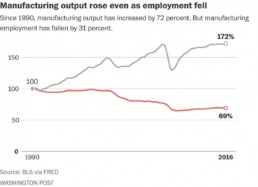
During the period after World War II, 70% of national GDP went to labor income, and the remaining 30% to capital income. John Maynard Keynes described the stability of the labor share as something of a “miracle.” But the rule has since broken down. Between the mid-1980’s and today, labor’s share of world GDP declined to 58%, while capital’s share rose to 42%.
Two forces in today’s digital economy are driving the global decline in labor’s share of total income. The first is digital technology itself, which is generally biased toward capital. Advances in robotics, artificial intelligence, and machine learning have accelerated the rate at which automation is displacing workers. The second force is the digital economy’s “winner-takes-most” markets, which give dominant firms excessive power to raise prices without losing many customers.
Although software platforms and online services can be costly to launch, expanding them is relatively inexpensive. And, once these firms are established and dominate their chosen market, the new economy allows them to pursue anti-competitive measures that prevent actual and potential rivals from challenging their position. Indeed, globalization may provide advantages to the largest and most productive firms in each industry, causing them to expand – and forcing smaller and less productive firms to exit.
This increased market concentration is widening the gap between the firms that own the robots (capital) and the workers whom the robots are replacing (labor). But confronting it will require us to reinvent antitrust for the digital age. As it stands, national competition authorities in G20 countries are inadequately equipped to regulate corporations that operate globally.
In the past, the G20 has focused on ensuring that multinational firms are not able to take advantage of jurisdictional differences to avoid paying taxes. But the G20 now needs to expand its scope, by recognizing that digital technologies are creating market outcomes that, if unchecked by a new World Competition Network, will continue to favor multinational firms at the expense of workers [competition-md].