MD tviti od 16.6.2017

Ideologije 19-ga+20-ga =zamenjala kompleksnost 21-ga stoletja. Globalizacija+tehnologije uhajajo nadzoru držav.1/4

2/When the philosopher points at the moon the fool looks at the finger. L.Pascal: Market capitalism is the moon. Globalization is the finger

3/ Zahodna paradigma determinizma=pase. Negotovost=vsakdanjost sodobnega sveta. Ker vse=povezano+v medsebojni odvisnosti → sistemski pristop

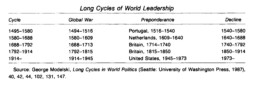
4/ Marx: kapitalizem vodi v krize/propad vs Kondratieff.: tehnološki preskoki na 50-60 let. In?!: cikli držav-hegemonov na 100-140 let.

Teksti v nadaljevanju so povzetki člankov:

The Global Age of Complexity
The Next Cycle of Capitalism
Missing the Economic Big Picture
The Globalisation Counter-reaction - The 1914 effect
The Global Age of Complexity
Andrew Sheng, Project Syndicate, Jun 12 2017 (Excerpt by MD)
https://www.project-syndicate.org/commentary/global-age-of-complexity-by-andrew-sheng-2017-06
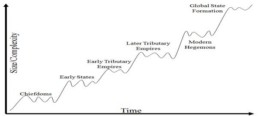
The nineteenth and twentieth centuries were ages of ideology and analysis, respectively. As for the twenty-first century, I would argue that it is the Age of Complexity. In this new age of complexity, we need a new paradigm for thinking about the world, and thus for guiding our efforts to advance peace and prosperity.
On the one hand, science and technology have progressed to the point that humans can create life and, through ultra-advanced genome-editing technologies, even engineer new species. Futurologist Yuval Noah Harari anticipates the imminent rise of Homo deus: a species of humanity that can “play god” by manipulating nature in myriad ways, including delaying and even conquering death.
On the other hand, much of humanity is besieged by feelings of helplessness and frustration, owing to the challenges we seem unable to resolve, from pollution and climate change to unrelenting radicalism and terrorism.
At a time when our power of creation, matched by our power of destruction, has reached unprecedented levels – when one weapons launch could change the course of history – the development of a more equitable and effective system could not be more urgent.
As we move to develop a new worldview to guide our future, we must embrace a truly global perspective. In the past, analysis of the evolution of humanity’s worldview has tended to focus on the West, following the European and, later, American progression from exploration, colonization, and empire-building, to industrialization, the diffusion of market relations, and technological innovation.
Humanity has long operated within a paradigm of determinism; we believe we can predict and manipulate outcomes. But we have not discovered any natural laws or equations that explain how life evolved into its current state, much less indicate how it will evolve in the future. Determinism has run its course, and must be replaced by a paradigm in which uncertainty is accepted as an irreducible fact of life.
Economics continues to operate in a largely linear manner. Indeed, the reductionist logic, based on simplistic assumptions, that dominates economics today is at best incomplete, and potentially fundamentally wrong. More broadly, a new “complexity worldview” must appreciate that human behavior is driven by everything from politics and economics to culture and psychology – even by technology itself. In an age of complexity, the institutions we build and sustain demand a system-minded approach. “The major problems of our time are systemic problems – all interconnected and interdependent.” Accordingly, “they require systemic solutions.
In the natural sciences, this is already happening. Quantum mechanics, general relativity, and uncertainty have been accepted as the way forward in physics and mathematics. In biology and neuroscience, there is a growing acceptance that life emerges through cognition (self-awareness and self-generation) and changes constantly. Yet in the social sciences – from economics to politics – this transition has yet to take place.
The Next Cycle of Capitalism
F.Salum and P.V.dos Santos Alves, Insead Knowledge, Feb 17 2017 (Excerpt by MD)
https://knowledge.insead.edu/strategy/the-next-cycle-of-capitalism-5226?utm_source=INSEAD+Knowledge&utm_campaign=757954d612-EMAIL_CAMPAIGN_2017_03_02&utm_medium=email&utm_term=0_e079141ebb-757954d612-249938249
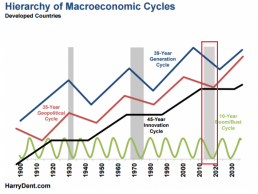
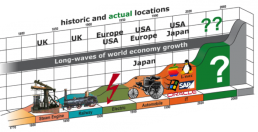
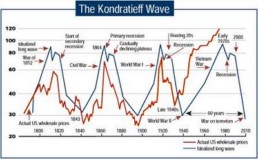
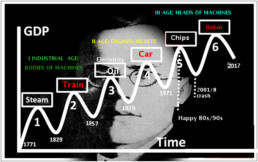
In the 1930s, the Soviet Union asked Nikolai Kondratieff, a mathematician, to create a model that would “prove” that capitalism would fall and communism would endure. Kondratieff studied economic history and reached the conclusion that economics was better explained by technology than class struggle. He observed that technology did not evolve linearly, but rather in leaps every 50 to 60 years. Named for the mathematician who made it famous, this pattern is called Kondratieff cycles or K-waves.
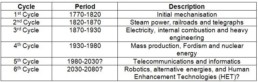
K-waves have been studied since and confirmed via spectral analysis. There is some controversy about the number of cycles and when they begin. Table 1 shows our own interpretation of the cycles and their defining technology. Our main research hypothesis involves the end of the fifth, and current cycle, as well as the existence of a sixth cycle. Kondratieff Cycles
The Crisis of 2015-2030 Each Kondratieff cycle ends with a general crisis. Karl Marx predicted capitalism as crisis-prone and believed this would lead to it falling apart. But Kondratieff found that capitalism reinvented itself with each crisis. As the saying goes, “desperate times require desperate measures” – giving rise to new solutions, investment in technology and new business models. These periods of crisis or struggle generally last between 12-15 years and eventually a new form of capitalism emerges.
As technology and the economy co-evolved new business models were created. Models like retail businesses, public companies, franchises, manufacturing, licensing, joint ventures, Private-Public Partnerships, umbrella brands, multinational corporations, venture capital, holdings, and trusts have all been developed to cope with an increasingly complex world.
We seem to be in a period of struggle now. Based on past trends, the predicted crisis of the current Kondratieff cycle should take place between 2015 and 2030. Looking back over Kondratieff’s Cycles, one aspect we cannot control is government. The political decision-making power of a handful of countries is the independent variable. This variable could decide our future and whether capitalism as we know it will continue.
Hegemonic stability theory indicates that international relations are more stable when a single nation is a dominant world power, or hegemon. Hegemonic cycles tend to run for 100-140 years before entering a period of transition and a new stability cycle. It remains to be seen whether we are at the end of America’s dominance as the global hegemon.
Missing the Economic Big Picture
J. Bradford Delong, Nov 28 2016 (Excerpt by MD)
https://www.project-syndicate.org/commentary/economic-trends-productivity-growth-inequality-by-j–bradford-delong-2016-11
Buddhist proverb: “When the philosopher points at the moon, the fool looks at the finger.” WTO General Director Pascal Lamy added that, “Market capitalism is the moon. Globalization is the finger.” With anti-globalization sentiment now on the rise throughout the West, this has been quite a year for finger-watching.
For starters, technological innovation in areas such as information processing, robotics, and biotechnology continues to accelerate at a remarkable pace. But annual productivity growth in North Atlantic countries has fallen from the 2% rate to which we have been accustomed since 1870 to about 1% now. Productivity growth is an important economic indicator, because it measures the year-on-year decline in resources or manpower needed to achieve the same level of economic output.
Measures of productivity growth or technology’s added value include only market-based production and consumption. But one’s material wealth is not synonymous with one’s true wealth, which is to say, one’s freedom and ability to lead a fulfilling life. Much of our true wealth is constituted within the household, where we can combine non-market temporal, informational, and social inputs with market goods and services to accomplish various ends of our own choosing. …synergies between market goods and services and emerging information and communication technologies.
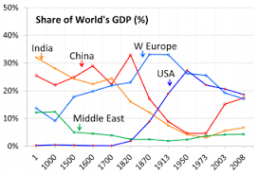
China, India, and some Pacific Rim countries have matched, or will soon match, North Atlantic countries’ productivity and prosperity. The rest of the world is no longer falling further behind the North Atlantic, but nor is it closing the productivity and prosperity gap, implying that these countries will continue to lag behind indefinitely.
The aforementioned features are all constituent parts of our proverbial market capitalist moon. As it develops and interacts with social, political, and technological forces, it creates elation alongside distress. Globalization is one piece in a larger puzzle: while it is important that we determine the best way to manage the global trade system, doing so cannot substitute for the much larger challenge of managing market capitalism itself.
By focusing on individual free-trade agreements, whether proposed or already existing, or on closing national borders to immigrants, we are looking at the finger and missing the moon.
The globalisation counter-reaction The 1914 effect
The Economist, Jun 14 2017 by Buttonwood (Excerpt by MD)
http://www.economist.com/blogs/buttonwood/2017/06/1914-effect
WHEN the Archduke Franz Ferdinand was assassinated in 1914, there were few initial indications that world war would follow. But was the subsequent war really an exogenous event? Or was it the near-inevitable consequence of the tensions resulting from the first great era of globalisation?
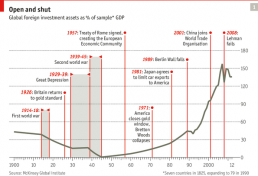
From 1870 to 1914, the first great era of globalisation saw rapid economic growth, trade that grew faster than GDP, mass migration from Europe to the New World and convergence of real wages between the old and new worlds. And yet in 1914, the great powers “sleepwalked” into war, as one author put it. Globalisation then went into reverse. It wasn’t until the 1960s or 1970s that trade recaptured its share of global GDP or countries like America started to re-open their borders to immigrants in a substantial way. Capital flows weren’t freed until the 1980s. The intervening period saw two world wars and a great Depression.
Globalisation was one of the forces that helped created the First World War because it has profoundly destabilising effects, effects we are also seeing today. In large part globalisation is about the more efficient allocation of resources—labour, capital, even land—and that creates losers. People don’t like change, especially when they lose from it. Clearly, the mid-19th century was a period of enormous change that was not just economic. In America, the industrial north defeated the agricultural south; Germany and Italy became nation states, and the multi-national Austro-Hungarian and Ottoman empires sunk into terminal decline.
Germany and America were able to catch up and, in the latter’s case, surpass the British economy. The pax Britannica in which Britain supported global trade through its powerful navy and financial system was weakened. Industrialisation meant that new sources of power emerged to challenge the old aristocratic elites. Elites turned to nationalism as a way of distracting voters from economic issues and shoring up their support. This nationalism led to clashes with the other great powers where their interests diverged; between Britain and Russia in Asia; Russia and Austria in the Balkans; Germany and France in North Africa.
As the powers sought to head off these challenges, they split into the triple entente of Britain, Russia and France and the triple alliance of Germany, Austria-Hungary and Italy. Britain worried about the growing economic power of Germany and entered a naval race; Germany worried about the growing power of Russia and wanted a war sooner rather than later. Confrontation looked more attractive than collaboration. … To sum up, globalisation disrupted both international power structures and domestic ones. This rapid change caused a reaction that was often violent. World War One was not inevitable but it was unsurprising.
So let us move to the current era of globalisation, during which the export share of global GDP has more than doubled since the 1960s. New economic powers have emerged to challenge American dominance; first, Japan, and now China and potentially India. Imperial overstretch threatens America as it did Edwardian Britain. The ability and, more recently, willingness of America to act as global policeman has been eroded. Indeed, unlike Britain in 1914, America is a net debtor not a creditor.
Migration has increased again, not quite to pre-1914 levels but in another direction: from the developing world to the developed. This has led to cultural and economic resentment among voters and imported the quarrels of other countries. We see terrorists on the streets of London, Manchester, Paris and Boston; all inspired by events thousands of miles away. Economic integration means that financial crises can quickly spread; just as American subprime mortgages hit the world in 2008, Chinese bad debt may do so in future.
Within the economy two big changes have occurred. Manufacturing capacity has moved from the developed world to Asia. Technology has rewarded skilled workers and widened pay gaps. Voters have rebelled by turning to parties that reject globalisation.
But we will see more resistance to globalisation from governments, as they calculate that voters will reward nativism. Foreign takeovers will be blocked. Domestic companies will be subsidised or favoured in government programmes. Tit-for-tat trade embargoes and tariffs will be imposed; the WTO could come under threat. Immigration will be discouraged, even of high-skilled workers. Populism can emerge from the left (higher taxes and nationalisation) as much as from the right; see Britain.
The real danger is that this is a zero-sum game. Governments will appear to grab a larger share of global trade for their own countries. In doing so, they will cause trade to shrink. That might make voters even angrier. From the early 1980s to 2008, most companies could count on a business-friendly political environment in the developed world. But it looks as if that era has ended with the financial crisis. Globalisation has caused another counter-reaction.
The best hope is that technology can deliver the economic growth and rising prosperity voters want. If that happens, these threats will not disappear but they will be much reduced. But for all the hype about new technology, productivity has been sluggish. The omens are not great.