“Europe needs true fiscal integration, not its own IMF”
The Economist May 9, 2017 http://www.economist.com/blogs/freeexchange/2017/05/completing-euro-zone
THE euro-zone debt crisis exposed a critical need for stronger European financial safety nets and institutions. In March 2010, Thomas Mayer and Daniel Gros, two German economists, made a strong case for the creation of a European Monetary Fund (EMF). In the end, European leaders agreed on a European Financial Stability Facility (EFSF) in May 2010. This was later transformed into the European Stability Mechanism (ESM), which today works alongside the IMF in Europe’s financial-assistance programmes. And in the summer of 2012 the banking union had been agreed by European heads of states and government.
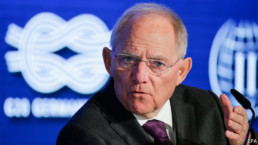
The ESM now needs to evolve. Wolfgang Schäuble, the German finance minister, is taking a proactive approach. He recommends that the ESM be turned into a true European Monetary Fund (EMF). It is an appealing idea. A more robust European crisis-management framework is required.
However, instead the euro area should promote fiscal federalism. This means completing the euro-zone policy framework with a real budget. The EMF as envisaged by Mr Schäuble is designed to force debtor countries to proceed with unilateral and often ill-designed adjustments—very much like the existing framework. Creation of a real budget for the euro area could materialise from a transformation of the European Stability Mechanism.
If European governments decided to strengthen the architecture of the euro decisively, they could bring the ESM under the authority of the European Commission. Additional functions could gradually be added so that the ESM would morph into a full-fledged euro-zone treasury. Initially, it could serve as a last-resort backstop in case of banking crises. It could subsequently expand its role to deliver the supply of safe assets required to respond to macroeconomic shocks. For the single currency to continue to be economically and politically sustainable, the euro area needs a budget that could support investment in downturns and facilitate limited, temporary transfers via an unemployment-insurance scheme.
All in all, the idea of an EMF sounds like a generous proposal to integrate the euro area and improve the workings of adjustment programmes.The main danger of this EMF would be to weaken European institutions further by strengthening the roles of the ESM which replicate existing capacity at the European Commission—making the board of the ESM, that is, the finance ministers of the Eurogroup, enforce rules and undertake responsibilities that the Commission is wrongly perceived to be unfit to fulfill. The experience of the past few years suggests that the intersection of 19 different red lines rarely meets the European general interest.
In contrast, a budget for the euro, managed by the Commission, would change the ineffective inter-governmental management of the single currency by empowering the commissioner for economic and financial affairs instead of the Eurogroup’s president. It would relieve the European Central Bank of politically sticky responsibilities. In addition, member countries need to increase democratic integration.
Eurozone does not need fiscal union – bailout chief
Financial Times November 1, 2016 https://www.ft.com/content/6d709ae5-5224-3879-8fb3-4e9b06aee075
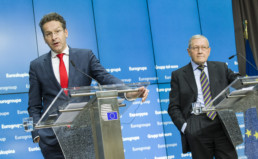
Klaus Regling, the German head of the European Stability Mechanism who has previously supported moves to create a separate eurozone parliament and treasury, said there was “no need for a full political union nor a full fiscal union”…. The fact that the economy is doing well – and that former programme countries such as Ireland and Spain are now Europe’s growth champions – shows that we do not need a full fiscal union.
Jeroen Dijsselbloem, the Dutch head of the eurozone’s finance ministers, said in September that deeper integration would be the “worst response” to EU’s multiple crises.
Extract from the two Articles by Milan Demšar 10.5.2017