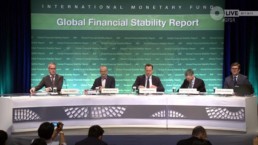
Excerpt from IMF Report, April 2017
by Milan Denšar, 10.5.2017
Global Financial Stability has continued to improve but challenges remain. Policy uncertainty is a key global risk. In the U.S., concerns about fiscal policy could push up interest rates. A shift toward protectionism could harm global growth and hurt market sentiment. Can U.S. corporations support economic expansion safely? Companies in key US sectors are highly leveraged. Emerging Markets continue to face high risks to their financial stability. European banks face structural challenges. So it is crucial to get the policy mix right.
World economic activity has gained momentum. With greater confidence in the outlook, hopes for reflation have risen, monetary and financial conditions remain highly accommodative. Investors’ optimism over the new policies under discussion has risen. But failing to get the policy mix right could reverse market optimism. It could also ignite new downs and risks to financial stability.
The US policies could increase fiscal imbalances and could push up interest rates and global raised premia. Shift out protectionism globally could drag down trade and growth, triggering capital outflows from EM’s. The loss of global cooperation on regulatory reforms could reverse some of the gains that have made financial system safer.
Markets expect this adverse development will be avoided and policy makers will implement the right mix of policies. In the US that means policies that will invigorate corporate investment. In the Emerging Markets that means addressing domestic and external imbalances to enhance resilience to external shocks. Finally, in Europe that means that policy would tackle the structuring causes of banks weak profitability. That is why the focus of this report is getting the policy mix right.
The key policy questions:
Can the corporate sector in the US enhance safe economic expansion? Discussions over tax reform, infrastructure spending and reduction of regulatory burdens have busted confidence. The bad news is that sectors counting almost half of the US investment economy namely energy, utility and real estate are already highly levered. Why is this problem? A sharp rise of interest rates for example is going to increase financial imbalances and could push corporate debt servicing capacity to its weakest level since the crisis.
Under such a scenario corporate with some four trillion dollars would find servicing the debt challenging. In the integrated world what happened in the developed world have repercussions on the EMs. We all remember sharp rise of interest rates in 2013 and EM’s suffered badly. Those are the banks that already experienced the bad quality assets along the long time credit boom. Is this time different? With divide policy mix it can be; even if interest rates and monetary policies normalize.
European banks holed high capital level, regulation has strengthened and supervision has been enhanced. At the last six months bank equity prices have risen and the recovery has firmed. But this is not the end of the story. We examined many European banks representing 35 trillion dollars of assets. Domestic focused banks face great profitability challenges. They still have one trillion dollars in NPL’s. In Europe more comprehensive efforts are needed to address banking system and bank business model challenges
China is the key contributor to global growth but has also notable vulnerabilities. Credit in relation to Chinas economy has more than doubled in less than a decade to over 200%. Credit boom this big can be dangerous. Involved are banks and shadow banking system.